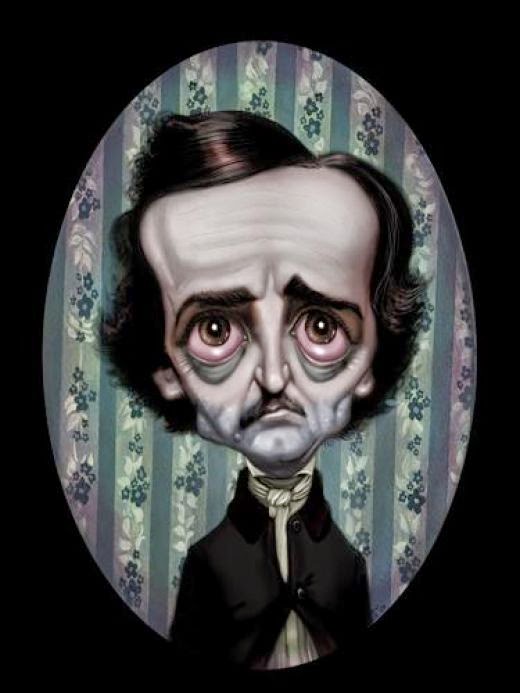
Edgar Allan Poe, Life imitates Art - Presentation

This is an Edgar Allan Poe presentation done for my American Literature Class


Works Cited

Barton, Edwin J. "Midnight Dreary (Book Review)." American Literature 73.2 (2001): 418.
Academic Search Complete. Web. 18 Mar. 2015.

Booth, Bradford A. "The Identity of Annabel Lee." College English 7.1 (1945): 17-19. Web.

Giammarco, Erica. "Edgar Allan Poe: A Psychological Profile." Personality and Individual
Differences 54.1 (2012): 3-6. Web.

Hurley, Richard. “Fear of Imminent Death.” BMJ : British Medical Journal 327.7408 (2003):
200. Print.

Poe, Edgar A. "Edgar Allan Poe, Short Stories, Tales, and Poems." Poestories. Robert Giordano,
27 June 2005. Web. 18 Mar. 2015.

--"Annabel Lee." Ed. Nina Baym and Robert S. Levine. The Norton Anthology of
American Literature. 8th ed. New York: W.W. Norton, 2013. 691-92. Print.

Semtner, Christopher P. "13 Haunting Facts About Edgar Allan Poe’s Death." Bio.com. A&E
Networks Television, 6 Oct. 2014. Web. 12 Mar. 2015.


Comments

Popular posts from this blog

Montresor’s Downfall A Psychoanalytical look at Edgar Allan Poe’s The Cask of Amontillado

            Psychoanalytic Criticism is an approach of critical thought that follows “how and why people behave the way they do,” this theory is practiced in more than one field outside of literature. Some theories have been developed alongside other literary theories and those have been further developed by different theorist. Psychoanalysis as a school of literary theory can focus on one or more than one aspect of a literary work by focusing on the author, a specific character, the literary text, and even the audience that is reading the text. The most famous critic of psychoanalysis is Sigmund Freud who developed the original theory consisting of the unconscious mind, the desires of a person or character, and a defense. Freud further developed this into the id, the ego and the superego. Each of these aspects of the theory is dominated by a particular aspect; the id is dominated by pleasure, the ego is dominated by realit...

The Modern Girls: Japan’s Generation of Change

The Modern Girls: Japan’s Generation of Change The modernization of the world that began during the industrial revolution slowly made its way across the word throughout the end of the nineteenth century and into the twentieth century. The Modern Girl or the Modern Woman was spreading throughout the world in the early twentieth century. When Western culture made its way to Japan the young girls no longer saw a need in their parents traditional ideals, they saw a freedom in clothing and self-expression that had once been frowned upon. Women wanted the right to vote, they wanted to work, and they wanted the ability to choose what they were able to do with their lives. Yet in Japan the Modern Girl, also known as modan gaaru or moga, became a subject of concern from those who valued traditional roles. Japan as a country wanted to preserve their national identity from industrialization while they adapted to the change that was sweeping the world. When the Modern Girl began to r...

The Eye Sees Everything Psychoanalysis and The Tell Tale Heart

            Psychoanalysis is one of the most well-known critical approaches in literature, it shows the literary critic the mental state of not only the main character, but the author as well. In the book Critical Theory Today , Lois Tyson describes psychoanalytic criticism as “The notion that human beings are motivated even driven by desires, fears, needs, and conflicts of which they are unaware – that is, unconscious.” (Tyson, 12) This theoretical approach was created by Sigmund Freud from his theories on the unconscious mind and that people repress the things they don’t want to remember and that they go through several stages when they trying to repress memories. Almost as if a person is dealing with the five stages of grief, the stages of repression follow a similar pattern these stages include selective “perception, selective memory, denial, avoidance, displacement, and projection.” (15) These stages come from what a ...